
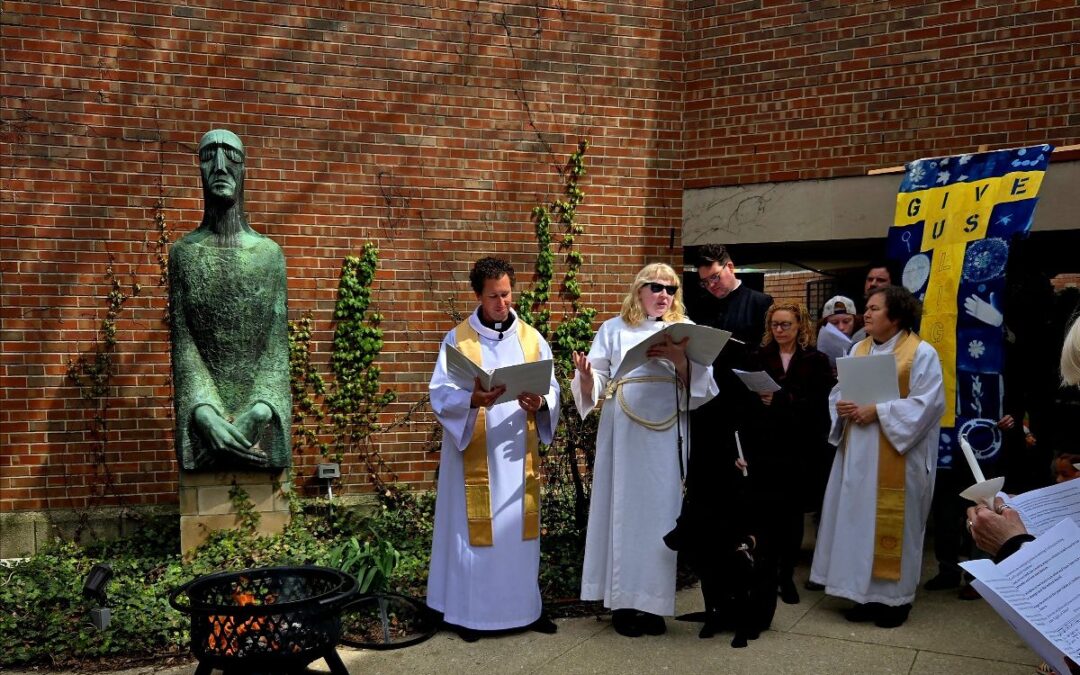
The ceremony began with the ritual burning of some coal in a small firepit outside the front door of Augustana Lutheran Church of Hyde Park, in Chicago. The coal fire was soon extinguished, but the flame was used to light candles as people processed, singing “This Little Light of Mine,” into the sanctuary for a special Sunday service to celebrate completion of the installation of solar panels on the building’s roof, which now power almost all the building’s electrical energy needs. The April 19 celebration included invited guests from the Chicago Department of the Environment, the Metropolitan Chicago Synod of the Evangelical Lutheran Church in America, Faith in Place, and the Hyde Park & Kenwood Interfaith Council.
The coal was scavenged from the nearby shores of Lake Michigan, where small chunks surface every year from a long-ago shipwreck of a coal-bearing vessel. It became a symbol of the congregation’s commitment to move away from our society’s past reliance on fossil fuels into a new future of renewable energy and better care of creation. But there was also a note of defiance in Pastor Nancy Goede’s opening statement: “As our country moves to embrace coal and fossil fuels once again, in our congregation we say, we are going in a different direction.”
Over the past three years, the members of Augustana had learned that realizing this commitment in a tangible way was not as easy as it may sound. The congregation has long expressed a willingness to commit to environmental stewardship. Its first effort at energy efficiency involved an overhaul of largely incandescent lighting in 1993 to compact fluorescent bulbs throughout the building, saving both energy and money. In the interim, it repeated that with an updated renovation. In the winter and spring of 2022, I led an eleven-week discussion of climate change in the weekly Adult Forum during the Sunday school hour, which led to people asking what the church could do differently to respond to the climate crisis. By that fall, the congregation had formed a Green Team, a congregational group affiliated with Faith in Place, an interfaith organization committed to environmental stewardship that is a three-state regional component of the national organization Interfaith Power and Light. The Green Team has maintained an active relationship with Faith in Place, hosting Green Team Summit watch parties and collaborating on larger projects. But there was also a latent hunger for something significant that Augustana could do to extend its commitment.
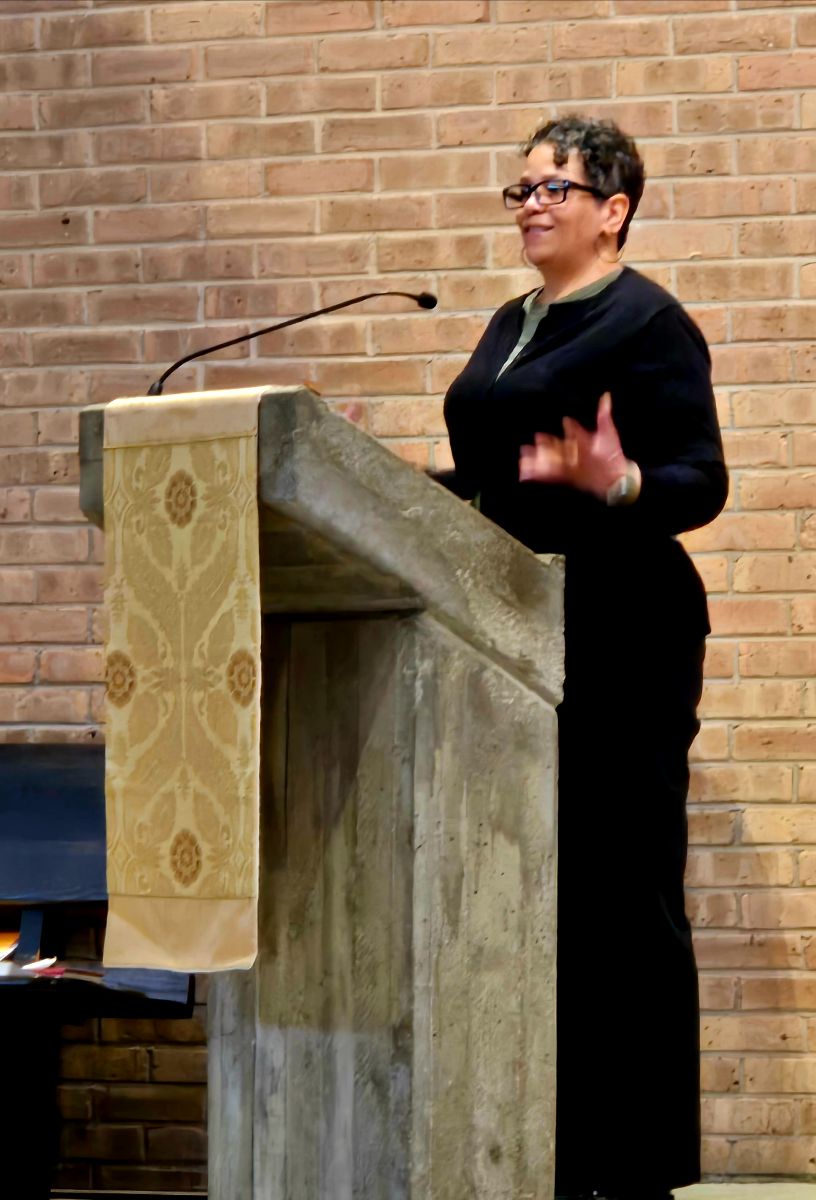
Lindy Wordlaw, Assistant Commissioner of the Chicago Department of the Environment, speaks at the celebration service.
By the summer of 2023, the City of Chicago, through its Department of Planning and Development, was arranging a second round of grant making for the Chicago Recovery Plan, funded in large part by federal funds from the American Rescue Plan Act. This program included the city’s Climate Infrastructure Fund, which was designed to support nonprofit and small business projects devoted to everything from renewable energy to green infrastructure, which includes a variety of nature-based solutions to problems like stormwater runoff. We discussed what might make the most sense for Augustana, and people focused on the idea of rooftop solar power as a starting point. By August, I was asked to prepare a grant proposal, a laborious effort to document not only what we proposed to do, but what impact it would have on our community.
On one hand, we needed the raw data of the project itself, which came from competitive proposals from solar installers and a roofing company. It was essential that the grant include funding to replace those parts of the roof that would support the solar panels because it would maximize the time the panels could remain in place before needing to be taken down even temporarily for roof repairs.
On the other hand, I worked with Augustana facility manager Jim Vondracek to document the dozens of “space partners” who use Augustana’s building for various civic and educational purposes, such as Alcoholics Anonymous but also the Hyde Park Jazz Festival, which performs there annually, the Hyde Park Refugee Project, and an annual vigil against gun violence. What this showed, critically, is that the project would benefit not only the members of Augustana, who themselves are spread throughout the South Side and beyond, but also a wide array of other users who help support healthy civic life in Chicago. In other words, Augustana seeks to be not just a presence in the community, but a reliable and conscientious neighbor.
About five months after submitting the proposal on August 20, 2023, we received good news from the city. Despite a level of proposals higher than the city had expected, Augustana would be the recipient of a $250,000 grant for the purpose of installing a rooftop solar system. Campus Pastor Matt Stuhlmuller and I attended the city’s grants announcement on January 30 on behalf of Augustana, and by mid-February some of us were immersed in city-led orientation sessions to discuss the terms of engagement for all categories of grant recipients. We were off to the races, or so we thought.
Much of 2024, however, turned into a gauntlet of paperwork and documentation for the city. In saying that, I do not want to imply that most or all of it was unnecessary or inefficient. As a retired urban planner with a BA in political science, I am well aware that these requirements exist in part to ensure that the city is working with honest and reliable partners in pursuing its goal of a more sustainable, climate-resilient community. And I don’t want to dive too deeply into the weeds here, but we discovered, among other things, that Augustana did not have a copy of whatever incorporation papers our archives suggested we once had. I learned more than I ever intended about nonprofit incorporation law in Illinois, particularly as it pertains to faith-based organizations, and in the end, we found that newly incorporating under modern Illinois law was our best path forward. Jim Vondracek also had to spend an afternoon at the county clerk’s office to obtain a copy of the deed proving that Augustana owned the property on which the building sits.
But the oddest and most taxing situation involved a notice that Augustana somehow owed thousands of dollars in delinquent sign fees. It turned out that prior notices of fees, which included decades-old permits for hearses to sit in front of the building during funerals, had never reached the church officers because, ever since the city had converted from mailed to emailed billings, it had been sending the invoices to an email address that belongs to another Augustana Lutheran Church in Minnesota. At one point, our treasurer asked someone with the city to correct the email address, only to be told that the address could not be corrected until we paid the bills that were due. But now that we knew about them, we were prepared to pay them except for a few that involved addresses connected to the University of Chicago. Facing a deadline of August 1, 2024, for signing a grant contract with the city, we decided to pay the $6,400 in contested invoices to avoid risking loss of the grant. We could seek a refund of those contested payments later and are doing so now that the project is complete.
In November 2024, voters nationwide chose to elect Donald Trump to a second presidential term. Although Augustana was preparing to work with its roofing and solar contractors (the latter acting as general contractor) to implement the project, we did not anticipate what hit us in January: notice from Windfree Solar that the price of solar panels, not yet locked in, would be rising because providers were anticipating large tariffs by the new Trump administration. Most solar panels used in the U.S. have been manufactured in China. What was odd was that this was not done with any intention of nurturing solar panel manufacturing in the U.S. Quite the opposite, in fact: Within the year, Congress, at Trump’s request, rescinded many of the renewable energy incentives built into the Inflation Reduction Act passed under President Joe Biden. I could write a whole other blog post about the damage done by the so-called Big Beautiful Bill Act with regard to renewable energy and other environmental priorities, but my point here is simply that we found ourselves maneuvering to secure a short-term building loan to cover the cost of the project because the city grants operate on the basis of reimbursement for expenses incurred. Our costs, originally below the $250,000 grant ceiling, soon exceeded that limit, which Augustana had to cover by using other funds to cover the difference. Our treasurer reassured us that the project still made long-term financial sense, an outcome I anticipated, and we chose to move forward even though overall costs ultimately approached $300,000. We had made a commitment, and we were not going to be deterred.
And so, the process moved forward. Tans Quality Roofing, a very reliable partner, completed the reroofing of two-thirds of the building in September 2025. Totally apart from the grant, they are now completing work on a middle portion that contains no solar panels but does contain HVAC equipment. By December, Windfree Solar had completed the solar panel installations, and by January 9, following city inspection and an interconnectivity agreement with utility Commonwealth Edison that allows us to sell excess power back into the grid, the system became operational.
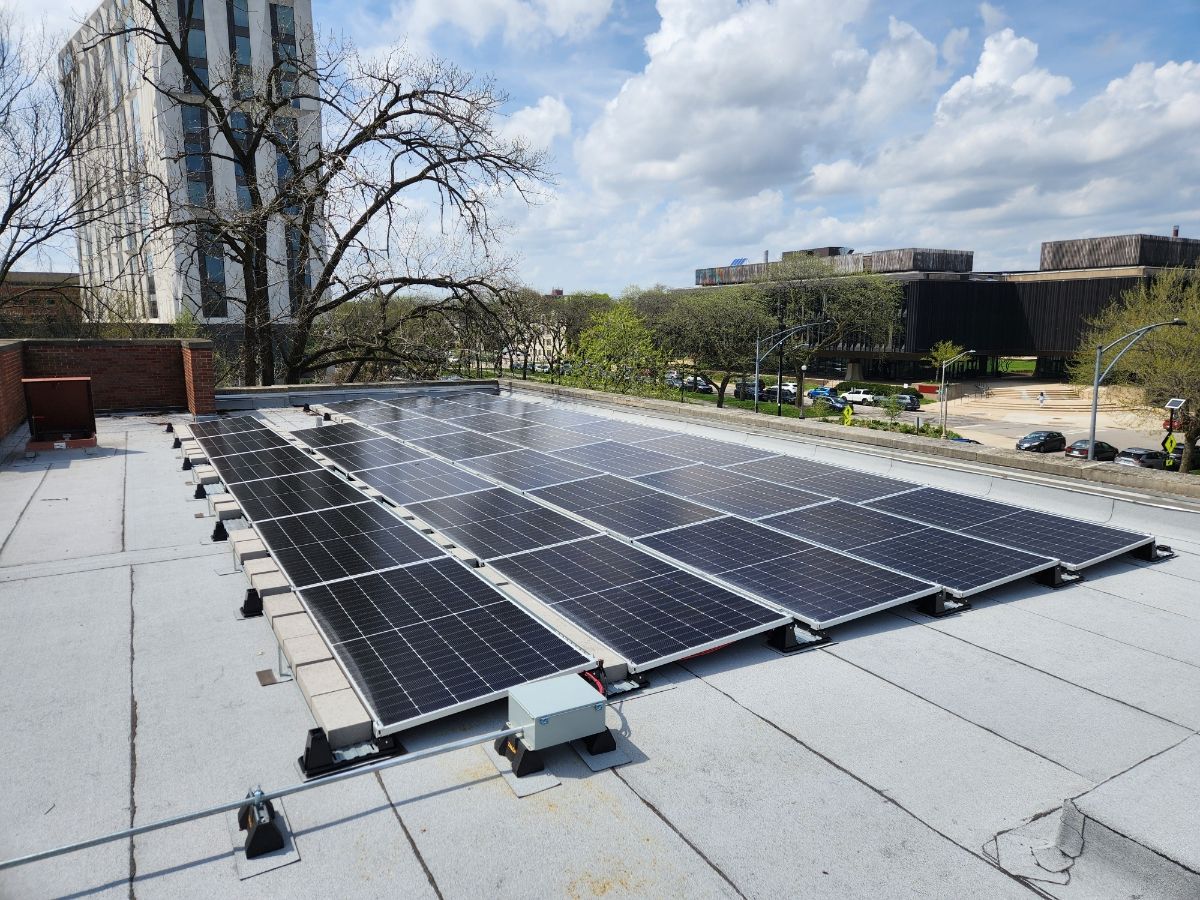 At least as proposed, we expect the system to produce a little over 100 percent of the building energy needs, drawing occasionally from the grid as needed, and generating excess power at other times. The original projection was that Augustana would save approximately $5,000 per year initially in energy costs and $200,000 over the next two and a half decades. We remain eligible for state and federal rebates totaling about $80,000 paid out over the next several years, providing the system remains in operation. Many people ask about those savings, which certainly contribute to long-term financial sustainability for the congregation.
But Pastor Goede prefers to note other reasons as the primary driver that sustained Augustana’s patience and persistence over a sometimes-taxing two-year effort to realize our solar dream. In her sermon for the April 19 celebration, using a reading from Jeremiah 32 about the prophet buying a field even as the armies of Babylon have laid siege to Jerusalem, she asked:
Likewise, how crazy is it for Augustana to put solar panels on top of our building, when all around us, everyone is talking about a return to fossil fuels for the United States. All around us, people are talking about oil shortages, but they are not talking about moving more quickly as a nation to solar and wind and geothermal power. Many people are all for burning up the future, literally.”
After explaining that ours is a God of hope, she concluded:
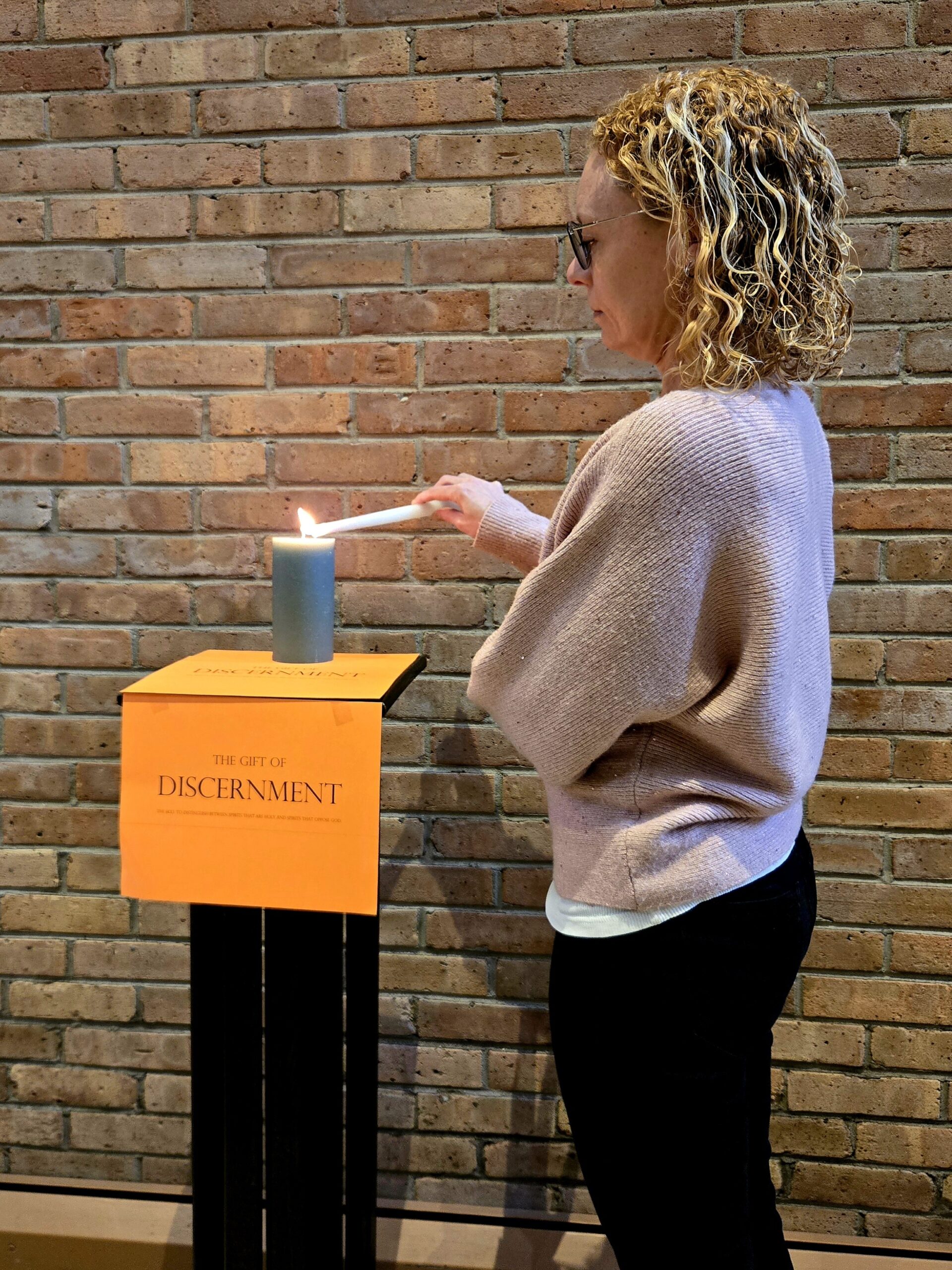
Green Team co-chair Elizabeth Roma lights a candle highlighting Discernment, one of the seven gifts of the spirit (Isaiah 11:2).
“Our solar project certainly drew on the gifts of many people. The panels will produce all the electricity we need, and that’s very good. But most importantly, our solar array is like Jeremiah’s field, a symbol of that for which we hope. Like the people of Jerusalem, we hope for a better everyday life for our city, a day when we might see many solar arrays and sustainable energy projects across Hyde Park and across our city. We hope for a day when our leaders hear a godly call to practice good stewardship and to protect the natural world and act for the common good and most vulnerable among us. Our panels tell others that while many in our country are running after Big Oil, we’re going in a different direction. We’re following the call of our God who hopes all good things for us in our beautiful natural world.”
To me, one of the most important aspects of this project was that it was very much a collective achievement. No one person could have made this happen. It was the result of collective commitment and perseverance.
The invited guests and I each had a few minutes to add our own remarks. I was speaking on behalf of the Green Team. My comments were prepared the day before the service; the pastor’s sermon and my remarks did not cross paths until that very morning, but somehow, I think, they were much in sync. I add them here to close this tribute to one of the most substantive and meaningful projects I have ever been part of:
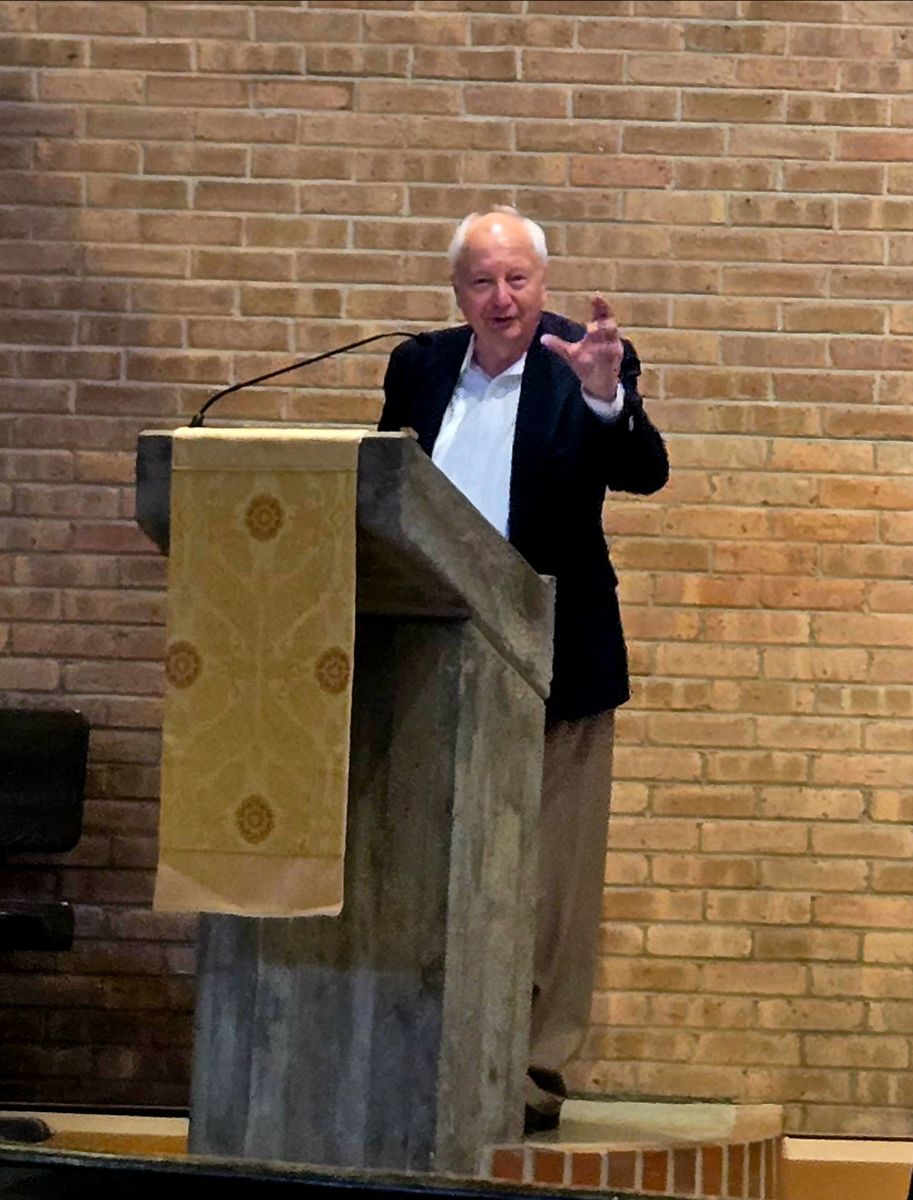
Jim Schwab speaks as a Green Team representative.
Good morning. This past Thursday evening, I attended another celebration, the annual Climate Action Hero Awards[1] ceremony of the Climate Action Museum, which the museum likes to call the “Green Oscars.” They also call them the Skillings, using a bobblehead of Tom Skilling, the long-time TV weatherman, who is a big supporter of Climate Action Museum. They follow Oscars protocol, putting a list of nominees for each award on the screens behind the stage, opening the envelope while announcing, “And the winner is . . .” and then bringing the winner on stage to accept and say a few words.
What is impressive is that the winners are not actors and producers, but mostly ordinary civic and business leaders and activists who have shown remarkable commitment to doing something meaningful and effective about climate change. One such leader is Crystal Gardner, an organizer for the Westside Environmental Justice Alliance, who won the Hazel M. Johnson Environmental Justice Award. I remember interviewing Hazel Johnson, a now deceased South Side community leader and founder of People for Community Recovery, way back in the early 1990s for Deeper Shades of Green, my book on the environmental justice movement. What the museum is doing by offering such awards is encouraging and supporting civic courage, the very first of our seven gifts of the spirit being highlighted today.
These people remind us of something very important that we should recognize today with the completion of the solar energy project here at Augustana, which itself was funded in large part with a grant from the City of Chicago’s Climate Infrastructure Fund, another commitment to environmental justice and climate action. That important something is that we at Augustana, and our remarkably dedicated Green Team, are not swimming in our own private pool, isolated from everything around us. We are swimming in vaster, deeper waters populated by tidal waves of inspired action to combat climate change and reverse the damage to our planet that has occurred for centuries. Despite all the despicable efforts in some quarters to turn back the clock on social and environmental progress, we are committed to moving forward. And we have lots of company, which is why we will soon hear from the City of Chicago, and our faith partners at Faith in Place and the Interfaith Council and the Metropolitan Chicago Synod. What we have done is an act of faith.
And we are not alone, and we should not be alone. In gratitude for our opportunity to display in a tangible and electric way our commitment to a just and sustainable environmental future for our planet, we must now take what we have learned and share it with others—other congregations, our neighbors, the community that surrounds us, whoever needs us. Go in peace, share the peace, to serve the Lord. Thank you.
Jim Schwab
[1] More on this appears in my previous blog post, “Biggest Job on the Planet.”