
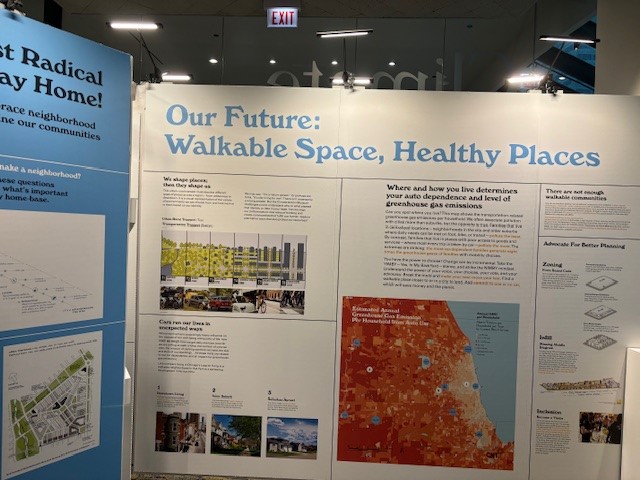
Once I was in downtown Chicago on April 16, at the corner of Adams and LaSalle, my first task was to enter what once was a bank building and pick up a name tag that had a number on the back. The second task was to take an elevator to the 40th floor and start meeting people at the third annual Climate Action Hero Awards, hosted by the Climate Action Museum (CAM).
Before you start wondering what that is, trust me: It is not yet a “thing” that every city feels it must have in order to establish itself in the world. In fact, there are, so far as CAM is aware, “only eight climate-focused museums globally.” The only other one in the United States is the Climate Museum in New York, but others exist in Bremerhaven, Germany; Hong Kong; Istanbul; London; and Rio de Janeiro.
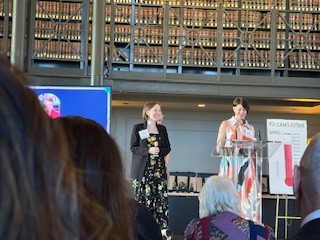 But that gives Chicago a leg up in offering the awards, which museum officers like to call the “Green Oscars,” but also the Skillings, named after Tom Skilling, a long-time television weatherman and civic icon in Chicago, who happens to be a big supporter of CAM. The awards are designed as Tom Skilling bobbleheads. We have a sense of humor in Chicago. Besides, the awards were bestowed at The Library, an event space whose walls are lined with law books and whose windows offer gorgeous views of the city.
But how did we get here?
The Energy Revolution
Four years ago, with no thought of its longevity, the Chicago Architectural Center (CAC) hosted an exhibit called The Energy Revolution, curated by a well-known Chicago architect, Doug Farr. Running from April 2022 through the following January, the exhibit proved both popular (34,000 visitors) and intellectually stimulating. It featured full-scale replica walls of buildings from the 19th, 20th, and 21st centuries with a provocative timeline showing that the earliest buildings, from the 1880s, were the most energy-efficient, those from the 1950s, at the height of the Glass-Box era, least efficient, and those from the 2010s somewhere in between. The exhibit fed into more recent desires to find ways to improve energy efficiency in all-electric buildings, preferably relying on renewable energy.
All good things come to an end, of course, and Farr had to decide what he wanted to do with the exhibit materials when the show ended. CAC asked if they should just landfill them, but supporters initiated contacts with the real estate industry to find a place to store them. Because the COVID pandemic had lowered occupancy rates in downtown commercial buildings, the Chicago Building Owners and Managers Association found six vacant spaces. The owners of 300 S. Riverside Plaza offered one year of rent-free, first-floor space facing the south bank of the South Branch of the Chicago River. Having visited more than once, I can attest that on a sunny day, it is a beautiful location. CAM opened in June 2023.
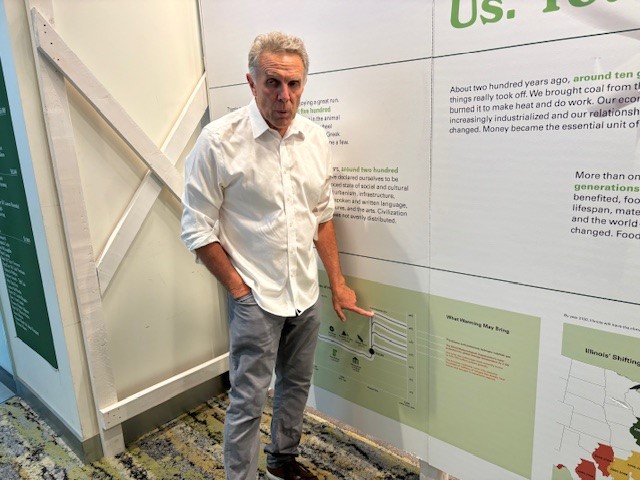
Doug Farr makes a point to museum visitors.
I can also attest that one attribute you can feel, more than see, is a certain vibrant energy, pushing visitors to think about what they can do to help combat climate change. The museum is not simply about entertaining your curiosity. It is very much about awakening an ardor for improvement. The stated mission is “to activate a tipping point on climate mitigation in the Chicago region through education, stimulating critical thought, and inspiring and facilitating action.” It does this so far with minimal staff, just one part-time coordinator and a bevy of enthusiastic volunteers. Nonetheless, one goal in raising funds is to make the coordinator’s job full-time and phase in an executive director. In short, if you care about climate change and want to get involved, the CAM board and volunteers are more than willing to engage your energy. Docents and board members already host about 100 events per year including group tours. The exhibits share information about everything from building energy use to the role of food production in climate change to lifestyle and city planning questions impacting climate.
Skillings, Skills, and Skin in the Game
At the annual awards, the host introduces a presenter for each award, who announces the nominees before opening an envelope, Oscar-style, announcing, “And the winner is . . . .” The Climate Action Hero Awards are designed to honor the civic, business, and political efforts of those who have made a difference in moving Chicago and Illinois in a more positive direction regarding climate resilience. They don’t honor glamor and talent so much as energy and creativity in tackling climate-related issues.
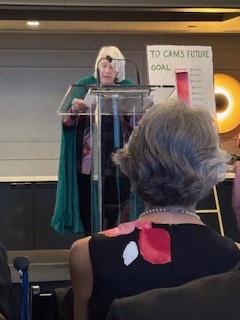
Dr. Adele Simmons, wearing her lifetime achievement cape, speaks to the CAHA audience.
For example, the Food and Agriculture Award this year went to Chicago Food Rescue, an organization that has rescued more than 300,000 pounds of food while expanding access for food-disadvantaged communities. The Climate Tech Award went to Eco Friendly Mobile Farm, which supports food distribution that is hyperlocal and does not use fossil fuels, in urban settings, for example, through electric mobile farm stands. Crystal Gardner, co-founder of the Westside Environmental Justice Alliance, won the Hazel M. Johnson Environmental Justice Award.[1] Meanwhile, Grace Brady won the first Youth Champion Award for leading the passage of state legislation supporting statewide climate education for K-12 students in public schools. The ceremonies concluded with a lifetime achievement award for Adele Simmons, the long-time president of the MacArthur Foundation, where she steered major philanthropic attention toward environmental and climate-related issues. All the awards featured people and entities who had made major investments of time, money, and/or energy in resolving climate questions.
But the museum’s own energy was on display during a fundraising break midway through the award presentations. Using a tiered system of support ranging from $10,000 down to $250, an auctioneer and volunteers raised well north of $30,000 from those present. That number on the back of your name tag? People showed that for quick identification once they had raised their hand and made a commitment, and volunteers raced around the hall to capture those numbers. This part of the ceremony concluded with an auction for dinner for six at an eco-friendly restaurant with Tom Skilling. The winning bid was $2,000.
Forging Ahead
“If there’s a theme to this year’s awards, it’s collaboration,” CAM board chair Lesley
Showers noted in an April 21 press release. She added that in Chicago, “we’re seeing people coming together in new ways to deliver real, lasting impact.” That seems to sum up the motivation behind the efforts of co-founders Doug Farr and Linda Sanchez, a green real estate leader and former board chair.
Seeking to enhance its visibility from a prime location, CAM has designed a new banner that will hang from the building on the north side of 300 S. Riverside Plaza, allowing an estimated 900,000 tour boat visitors annually to see that the museum is inside. Visibility is key to expanding public awareness and engagement in a city that is already favorably disposed toward climate resilience and equity. It is also a city where a decent amount of philanthropic engagement occurs related to environmental and social progress. Illinois, as a state (see awards list below), has made notable progress in enacting support for renewable energy and climate equity, including a Clean Energy Jobs Act. Just this year, it moved forward in strengthening the state’s commitment to sustainable mass transit by passing legislation to create the Northeast Illinois Transit Authority, consolidating several existing agencies in a more coherent regional framework, an achievement honored by CAM’s new Government & Legislation Award.
Still, building a future for such a museum remains an uphill effort but one that does not seem to daunt the leadership or volunteers. It’s been around for three years and aims to stick around much longer. The museum is well worth a visit if you don’t mind being confronted with the truth about our climate dilemma. Confronting and adapting to climate change is, after all, truly the biggest job on the planet.
Jim Schwab
Supplement: The Winners
The following is borrowed directly from the aforementioned press release and included here to avoid cluttering the narrative in this blog post. But the list helps to illuminate the various directions in which the Climate Action Museum is taking its activism:
- Champion Award:
○ Katie Kulunzy, recognized for her leadership at Illinois Green Alliance and with the Village of Brookfield, and for advancing building decarbonization through the Building Energy Hub.
○ Grace Brady, recipient of the inaugural Youth Champion Award, recognized for leading the passage of statewide climate education for K-12 students in Illinois.
- Climate Tech Award:
○ Eco Friendly Mobile Farm, recognized for enabling fossil fuel-free, hyperlocal food distribution in urban settings through electric mobile farm stands, increasing the reach of small urban farms throughout Chicago.
- Hazel M. Johnson Environmental Justice Award:
○ Crystal Gardner, co-founder of the Westside Environmental Justice Alliance, recognized for having advanced community-driven solutions to environmental inequities on Chicago’s West Side.
- Education Award:
○ University of Chicago EPIC, recognized for leading interdisciplinary research and policy work on climate and energy.
- Business Award:
○ Next Haus, recognized for building high-performance, sustainable homes, including Evanston’s first Certified Passive House.
- Food and Agriculture Award:
○ Chicago Food Rescue, recognized for rescuing more than 300,000 pounds of food and
expanding access for food-insecure communities.
-

Evanston, IL, Mayor Daniel Biss, a former award winner, announcing the Government & Legislation award.
Government & Legislation Award:
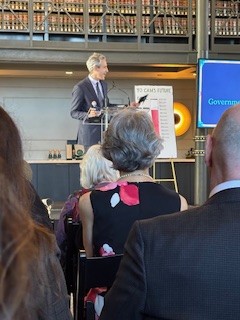
○ Northeast Illinois Transit Authority legislation. This landmark effort unifies oversight of
CTA, Metra and Pace, addressing the transportation sector, the largest source of greenhouse gas emissions in Illinois, through systemic reform and historic investment.
- Tom Skilling Lifetime Achievement Award:
○ Adele Simmons, in recognition of her decades of leadership advancing sustainability, philanthropy and civic engagement.
[1] Hazel Johnson, now deceased, was the founder and long-time leader of People for Community Recovery on Chicago’s South Side. In 1992, I interviewed her at length for Deeper Shades of Green, my book on the nationwide emergence of the environmental justice movement.